Discover our Products



MagiCoder Pro
MagiCoder Pro is a tool that automatically recognizes the terms of a given dictionary within a free form text, such as (but not limited to):
- MedDRA terms in adverse drug reaction reports (ICSRs);
- ICD terms in medical records (EHRs);
- IDMP terms in Summaries of Product Characteristics (SmPCs).
Example outputs are shown in the following table.
| Source Text | Given Dictionary | Recognized Terms |
|---|---|---|
| «After taking the antibiotics, the patient experienced erythema and edema on the wrists and ankles» | MedDRA | «10015150 Erythema», «10076565 Wrist edema», «10002542 Ankle edema» |
| «Each film-coated tablet contains leflunomide» | IDMP | « 100000085463 Leflunomide», «100000073665 Film-coated tablet» |
Table 1 Example of MagiCoder Pro outputs
MagiCoder Pro supports multiple dictionaries and multiple languages.
It’s also fast (as it returns the results in milliseconds) and has high reliability (it finds up to 90% of the terms in the source text on average, regardless of declensions, punctuation, typos, and so on).
Even more, it’s integrable in other software or workflows (via API) and is self-hostable (via Docker).
Finally, it can also be used with a Mozilla Firefox extension to encode the selected text on any website or PDF opened in the browser.
MagiCoder Pro is available in two versions:
- the Managed version is for those who want to reduce operational overhead and get faster access to its features;
- the Self-hosted version is for those who prefer full control over the software and prioritize confidentiality.
In the managed version, INSPIRE is responsible for running MagiCoder Pro, providing the hardware (a dedicated virtual machine sized to the user’s needs) and handling the installation and configuration of the software with the user’s preferred dictionaries.
In the self-hosted version, the user is responsible for running MagiCoder Pro. INSPIRE will provide a Dockerized release of the software and several scripts to start (or stop) one or more containers on a dedicated virtual machine, within the user’s infrastructure.
Find out more on the official website
Pharmacovigilance Kit
Pharmacovigilance Kit is a web application whose primary goal is to simplify the generation of individual case safety reports (ICSRs) in the format currently accepted by regulatory authorities’ systems – which is called E2B R3, an international standard that defines how electronic individual case safety reports (ICSRs) should be transmitted between stakeholders.
It is not intended for end users, but for technical users who may like to integrate it (via API) into their organization’s applications and/or data workflows. For example, one can use it to easily convert the data collected in a research or clinical study to valid ICSRs for EMA EudraVigilance. That’s because with Pharmacovigilance Kit users can work with a more friendly physical data model for E2B R3, switching back and forth between the “only machine-readable” XML format to the “also human-readable” JSON format.
In the current version, Pharmacovigilance Kit allows users to:
- Retrieve all E2B R3 related controlled vocabularies (also the ISO IDMP ones).
- Convert safety reports from JSON to XML E2B (R3).
- Convert safety reports from XML E2B (R3) to JSON.
- Convert safety reports from XML E2B (R3) to HTML.
In upcoming versions Pharmacovigilance Kit will also allow users to directly transfer ICSRs to EudraVigilance, and it will be self-hostable.
In the past, the core library of Pharmacovigilance Kit was used in CovidVaccine-Monitor (CVM) project to generate E2B-compliant ICSRs for EudraVigilance, from data collected with Research Online.
Pharmacovigilance Polaris
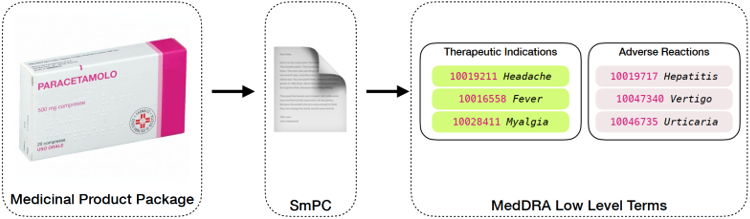
Pharmacovigilance Polaris is a tool that generates a query-able archive of therapeutic indications and adverse drug reactions reported on Summary of Product Characteristics (SmPCs). Within the dataset, all medical concepts are encoded as MedDRA Lowest Level Terms (LLTs).
Pharmacovigilance Polaris currently works with Italian SmPCs, automatically downloading those published at AIFA Medicinali website. Nevertheless, it could be extended, on request, to other datasources.
It can be used for:
- Safety reports analysis: to check if a reaction is known for a drug, detect an off-label use of a drug, or sort drug-reaction pairs in signal detection.
- SmPCs harmonization: to check inconsistencies among medicinal products with the same pharmaceutical composition.
- Drug deprescription: to automatically spot medical conditions treated by a drug that could be adverse reactions of another one.
In upcoming versions Pharmacovigilance Polaris will also provide data on adverse drug reaction frequencies and support semantic similarity search.